Upper Egypt
Two rock-cut temples on the shore of Lake Nasser, moved 65 metres uphill and 200 metres inland in the 1960s to save them from the rising waters of the Aswan High Dam. The greatest archaeological rescue operation in history.
The Monuments
Abu Simbel comprises two temples carved directly into the sandstone cliff face of the western bank of the Nile, approximately 280 kilometres south of Aswan. Both were commissioned by Pharaoh Ramesses II (1279–1213 BCE) during the height of the New Kingdom's imperial power and Ramesses' personal propaganda machine. The Great Temple is dedicated to Ramesses himself, deified alongside the gods Ra-Horakthy, Amun, and Ptah. The smaller Temple of Hathor (commonly called the Temple of Nefertari, after the queen depicted on its facade) honours Ramesses' principal wife and the goddess Hathor — making it one of only two Egyptian temples dedicated to a queen consort.
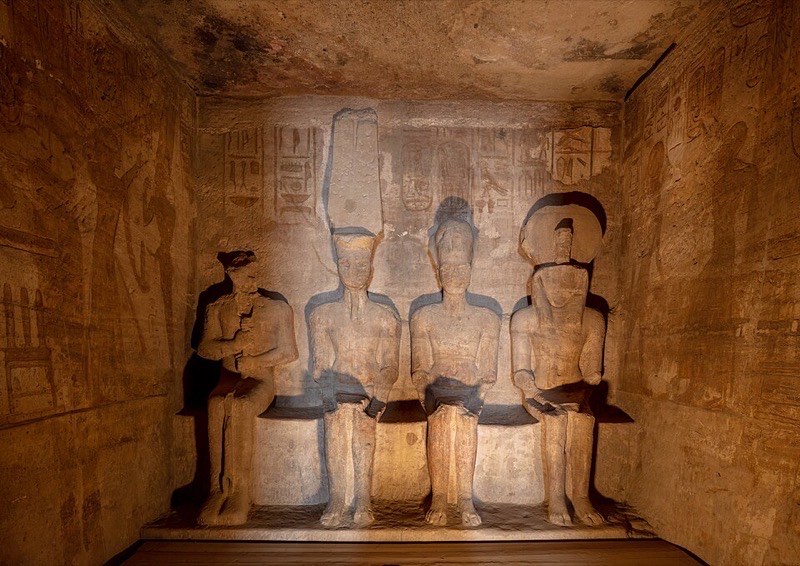
The Great Temple's facade carries four seated colossi of Ramesses II, each 20 metres tall, flanking the entrance. Inside, the hypostyle hall contains eight Osirian statues of the king, 10 metres tall, supporting the ceiling on both sides. The innermost sanctuary contains four seated deities — Ptah (god of the underworld), Amun-Ra (king of gods), Ramesses II himself as a deified figure, and Ra-Horakthy — carved from the living rock in a deliberate arrangement with astronomical significance.
Twice a year — on or around 22 February and 22 October — the rising sun penetrates the full 63-metre depth of the main axis and illuminates the four seated figures in the sanctuary. Three of the four are bathed in light; the figure of Ptah, the god of darkness, remains in shadow. Scholars believe these dates correspond to Ramesses' birthday and his coronation date respectively, though the precision of the alignment after the 1960s UNESCO relocation shifted the original dates by one day. Several hundred visitors gather on these mornings each year.
Engineering History
When the Egyptian government announced plans for the Aswan High Dam in the late 1950s, engineers calculated that the resulting reservoir — Lake Nasser — would permanently submerge Abu Simbel beneath 60 metres of water. UNESCO launched the largest cultural-rescue campaign the world had ever undertaken.
Between 1964 and 1968, an international consortium of engineers, archaeologists, and contractors — representing 51 countries — cut the two temples into 1,036 precisely numbered sandstone blocks, each weighing between 10 and 40 tonnes. Every block was photographed, measured with photogrammetric precision, and catalogued before removal. The blocks were transported to the new site 65 metres higher in elevation and approximately 200 metres from the original cliff face, where they were reassembled within purpose-built reinforced concrete domes designed to replicate the feel of the original rock interior while protecting the structure from the massive pressure that rock cutting would otherwise provide.
Approximately 2,000 workers were involved at the peak of the relocation. The project cost USD 80 million at 1968 values — roughly USD 700 million adjusted to 2026. It was jointly funded by contributions from the 51 member states that participated in the UNESCO campaign. The operation established the precedent for World Heritage Site designation and the principle that monuments of "outstanding universal value" are the shared responsibility of all humanity, not solely the host nation.
The original quarry where the blocks were cut, and the concrete dome visible from behind the temple hill, are part of the site's interpretive offering. Egypt Pass members can access a specialist briefing on the engineering and conservation decisions involved, led by a structural archaeologist familiar with the project documentation.
Director-General Vittorino Veronese issues the international call to save the Nubian monuments from the rising waters of Lake Nasser.
Swedish firm VBB and Egyptian contractors begin the complex process of scoring the sandstone face and cutting the temples into numbered blocks.
All 1,036 blocks safely removed and stored. Temporary coffer dams protect the site during the intermediate phase.
The two temples are fully reconstructed at the new site. The solar alignment is verified and found to be within one day of the original dates.
Abu Simbel inscribed on the World Heritage List as part of the Nubian Monuments designation alongside Philae and Kalabsha.
Getting There
EgyptAir operates daily direct flights from Aswan International Airport to Abu Simbel (approximately 45 minutes). This is the fastest option and is strongly recommended for visitors with limited time. EgyptAir also operates less frequent direct services from Cairo International Airport (approximately 90 minutes). Flight prices vary considerably by season; booking 4–6 weeks in advance typically yields the best fares. The Abu Simbel airport is directly adjacent to the site; a 5-minute walk brings you to the entrance.
The 280-kilometre desert highway from Aswan to Abu Simbel is served by air-conditioned tourist buses (departing the Aswan bus station approximately 04:00, returning late afternoon) and by private vehicle. The road runs along the west bank of Lake Nasser through a largely featureless desert landscape; fuel is available at Kalabsha (approximately 30 kilometres south of Aswan) and in Abu Simbel town itself. Private car hire for the return journey (approximately 4 hours each way) is the most flexible option, typically costing 800–1,200 EGP for the vehicle.
Abu Simbel is open daily from 05:00 to 18:00 year-round. Entry for international adult visitors: 450 EGP (tickets purchased at the site entrance; no advance purchase facility as of 2026). The site includes both temples, the surrounding open-air area, and the interpretive panels explaining the UNESCO relocation. Photography inside both temples is permitted without flash. Video recording: 50 EGP additional fee.
The famous twice-yearly solar illumination of the inner sanctuary statues occurs on 22 February (±1 day depending on weather and atmospheric refraction) and 22 October (±1 day). These dates draw several hundred visitors and a significant Egyptian television and media presence. The alignment light enters the temple beginning at approximately 06:00 and is most precisely centred on the sanctuary at around 06:10–06:25. Arriving the previous day and staying overnight at the Abu Simbel Seti resort is strongly advisable to secure a position for the event.